Life in a National Park
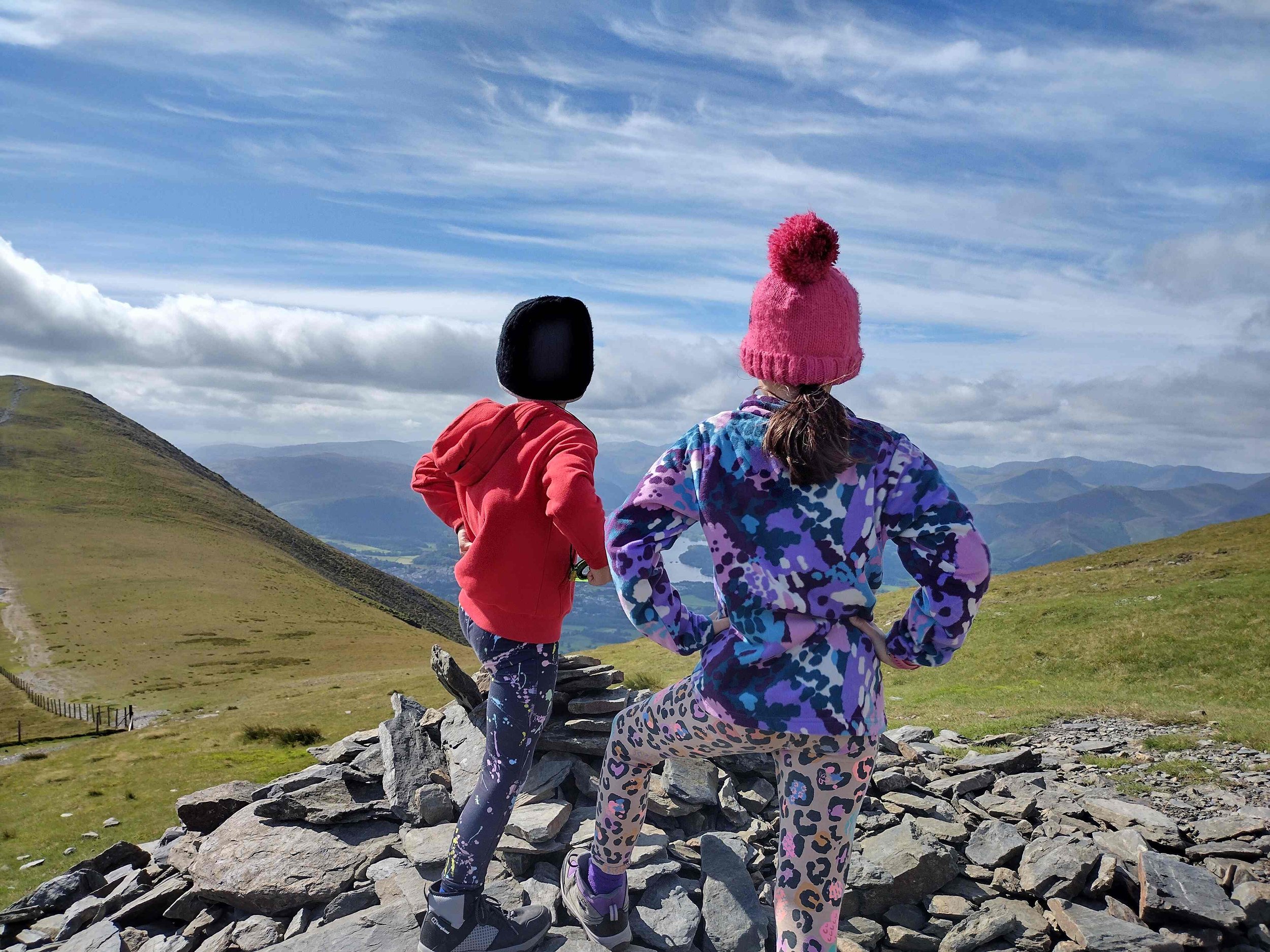
Two young mountaineers survey Derwentwater from the slopes of Skiddaw © Author photo
By Tim Thorlby
5 min read
This blog celebrates the 75th birthday of our National Parks. It also reflects on the acute challenges of managing these popular areas of natural beauty in ways that benefit their local communities. In particular, I reflect on a recent trip to the Lake District and explore where my money ended up. Yes, reader, I analysed my own holiday. How much of my spending benefited the local community? Let’s find out.
1 | “Carrot cake, anyone?”
We had a lovely week’s half-term holiday in the Lake District recently. It was strangely warm and sunny for Cumbria - too hot to climb mountains really, so we paddled in lakes, climbed some of the smaller hills and ate copious quantities of carrot cake. Delightful.
We are very fortunate to have National Parks in the UK – doing their best to protect nature and the landscape for generations to come.
They also have a very difficult balancing act to perform, as they also try to ensure that the local communities who live in the parks can still afford to buy homes and earn a living. They do this with limited powers, a shoestring budget and the need to work in partnership with a plethora of local and national organisations. So, it’s difficult.
Our National Parks are celebrating their 75th birthday this year. The Peak District National Park was the first park to be officially designated in 1951, shortly followed by others. There are now 15 National Parks, with 10 in England, 3 in Wales and 2 in Scotland. (Pub quiz question: how many can you name?)
This blog is a celebration of the work of all of our National Parks as well as a reflection on some of the acute challenges facing them - particularly their economic balancing act.
2 | A brief aside about ‘The Vision Thing’
Before we get to the main course, though, it is worth noting that our National Parks were established by the post-war Attlee Government, through the National Parks and Access to the Countryside Act 1949.
Not only did Clement Attlee’s Labour Government have to rebuild the country and its economy after a major world war, it was contending with a devastated Europe and a disintegrating British Empire. The government was nearly bankrupt. Attlee was also not well regarded at the time – rather shy, not a great speaker, definitely not in Churchill’s league; his own colleagues tried to get rid of him several times before he became Prime Minister.
Yet out of this chaotic mess emerged the NHS, a new welfare state, a whole new approach to the economy (through nationalising key industries), the building of a million houses, the founding of NATO and…a network of National Parks. How on earth did they have time to fit in the creation of National Parks?!
It seems that consequential and reforming governments don’t need to wait for the sun to shine before they act, they can deliver transformational change in spite of enormous constraints, as long as they have the vision and the drive to do it and are prepared to take bold decisions.
Our current generation of political leaders seem shy of grasping nettles and tackling major reforms. We could do with a few more Attlees – modest people with big visions.
Just saying.
3 | Four-dimensional chess and a shocking discovery
Anyway, back to the Lake District.
One of the most challenging aspects of managing a National Park is balancing the need to protect the natural environment and its landscape against the perfectly reasonable desires of the local community to earn a living and yet also manage the growing number of visitors. Tensions abound. It’s like four-dimensional chess.
We can’t just let people build and develop wherever they want, this is clearly not great in a National Park, but we need to let businesses function and the locals want houses to live in. The crowds of visitors complicate matters because they drive a lot of the local economy (mostly a good thing) but also bring congestion and pollution and they stimulate demand for more development (a challenging thing).
Here is the trilemma in three numbers:
There are only 39,000 people living in the Lake District National Park.
There are 673,000 sheep, however, including the famous Herdwick sheep, often to be found munching noisily on a hillside.
At the last count there were just over 18 million visitors to the Lake District per year (2022)[1], so a lot more visitors than sheep. (You can insert your own jokes here). They spend over £2.4 billion per year within the National Park. (The visitors, not the sheep).
Of the c22,000 jobs in the National Park, the vast majority are tourism related – some 15,000 – with only 2,735 people employed in farming. So, much as farming shapes the landscape, tourism is the mainstay of the economy.
How lovely! Oh, wait…
All is not well though.
For all the picturesque scenery, the local community experiences significant challenges. Many jobs in the Lake District are low-wage, often minimum wage (pubs, cafes, etc), house prices are very high and a staggering one in four homes are second homes or self-catering accommodation. In some villages it is as high as 70%. This has even led to questions in the House of Commons[2].
What is most curious is that with 18 million visitors, spending £2.4 billion every year (quite a lot of money), a surprisingly small amount of this filters down to the local communities.
One of the biggest issues facing the Lake District – and one of the reasons why the growing number of visitors never quite seems to benefit local communities much – is that the Lake District National Park has a major leak.
Not water.
Money.
4 | Is the Lake District leaking (money)?
After my recent week’s holiday, and being a bit of a geek, I did some analysis of my own spending whilst on holiday and I was rather shocked by what I found.
I worked out how much money we spent overall and then, within this, how much we spent with locally-owned businesses and how much was spent with businesses or organisations based outside of Cumbria.
Only 20% of what I spent in the Lake District was with a locally based business, council or other local organisation. With these organisations, much more of the money stays within the community. With a national organisation, all of the profits and much of the financial benefit ‘leaks out’ to other people and places, even if it is employing local people to deliver the service.
Here’s a quick summary of how our family’s money was spent in the Lake District:
Nationally owned businesses
Self-catering accommodation 53%
Supermarkets 15%
Nationally-owned attractions 5%
Nationally-owned shops 3%
Car/fuel costs 4%
TOTAL 80%
Locally owned businesses
Local cafes, pubs & shops 15%
Local attractions (boat trips, etc) 4%
Local council car parks 1%
TOTAL 20%
This is obviously a highly unscientific sample of one. However, it illustrates a wider issue.
If local people in the Lake District owned more of the businesses, rather than just working in them as employees – then more of the economic benefits of tourism would accrue to local communities, without any increase in visitors. They would receive the profits, not just the wages.
There are many avenues we could go down at this point, but what clearly stands out in this example is how the ownership of the self-catering accommodation alone makes a huge difference. We happen to know from neighbours that the property is owned “by a chap down south”. I am sure he pays his local business rates, so some of the financial benefits are retained locally, but when we paid our fee to him, the majority of our holiday money left the Lake District immediately; it was our biggest expense by far.
So, the question of who owns housing in our National Parks, and how much of it is deployed for tourism, is a major issue for the local communities there.
Rethinking how this works could make a substantial difference to those who live and work there.
5 | Who owns the Lake District?
I think there are two fairly obvious responses to this, neither of them new:
Second homes are a luxury that our National Park communities cannot afford – I am not generally in favour of banning things, unless there is good evidence that something is causing harm. Well, in our National Parks, widespread ownership of second homes is clearly causing demonstrable long-term harm to the local communities. Many are unoccupied for long stretches of the year and an empty house is no good to anyone. So, the practice of owning second homes, in our National Parks at least, should probably now be banned. This would free up a surprising amount of housing.
Tourism accommodation needs to be managed – All self-catering accommodation, including the use of AirBnB, should be registered, licenced and managed, to prevent over concentrations in particularly attractive areas. I have blogged previously about the impact of ‘too much AirBnB’ in an area and much the same economic arguments apply to other forms of self-catering and second homes. Tourism is a wonderful thing but if it is undermining the local community, it needs to be managed to secure a better balance. The Government are in the process of (slowly) bringing in a rather tame registration scheme for all of this, but local authorities need to be given proper powers of regulation to go with this.
These two changes would free up more housing for local residents to actively live in but would not necessarily result in greater local ownership within the tourism sector. They do not address the issue of who owns properties and who is making the most profits – a classic rentier economy problem (see my previous blog on rentierism if this is new to you).
So, I think I would go further.
I’m not entirely sure what the answer is, but I think we may need to innovate and be a bit more radical.
What about an additional Absentee Landlord Property Tax payable by owners of holiday accommodation in a National Park if they do not themselves live in the National Park? This would effectively be a tax on absentee landlordism, repatriating more of the money to those living within the area and disincentivising distant ownerships. It could easily be collected (and retained) by the local authority when it collects the local Business Rates (which it does already on these properties). Just a thought.
The Friends of the Lake District are already campaigning on some of this agenda - for greater planning controls and regulation of holiday accommodation. There is also discussion of a Visitor Levy, as a way of raising funds for more investment into the National Park. This is not a bad idea, although it misses out day trippers. Maybe a Vehicle Levy instead?
6 | Conclusion
Anyway, Happy Birthday National Parks!
Managing all of the competing interests in our National Parks is challenging to say the least.
We must continue to hold on to the original vision of protecting this land for the benefit of all, whilst being prepared to adapt to changing circumstances and try new approaches.
Conservation requires innovation.
I must go now. I’m feeling a strong urge to eat carrot cake again.
This blog was written by Tim Thorlby. Please sign up if you’d like to know about future blogs, usually published once a month, all free.
Notes
[1] Lake District National Park (2023) State of the Park | Access: https://lakedistrict.gov.uk/wp-content/uploads/2026/02/State-of-the-Park-Report-Nov-2023-vPSV.pdf
[2] See the Lake District National Park’s website for the latest facts and figures. Early Day Motion 2198 was tabled in the House of Commons in November 2025, raising the issue of lack of affordable housing in the Lake District | Access: https://edm.parliament.uk/early-day-motion/64622/second-homes-in-the-lake-district