
Manchester: city of the future?
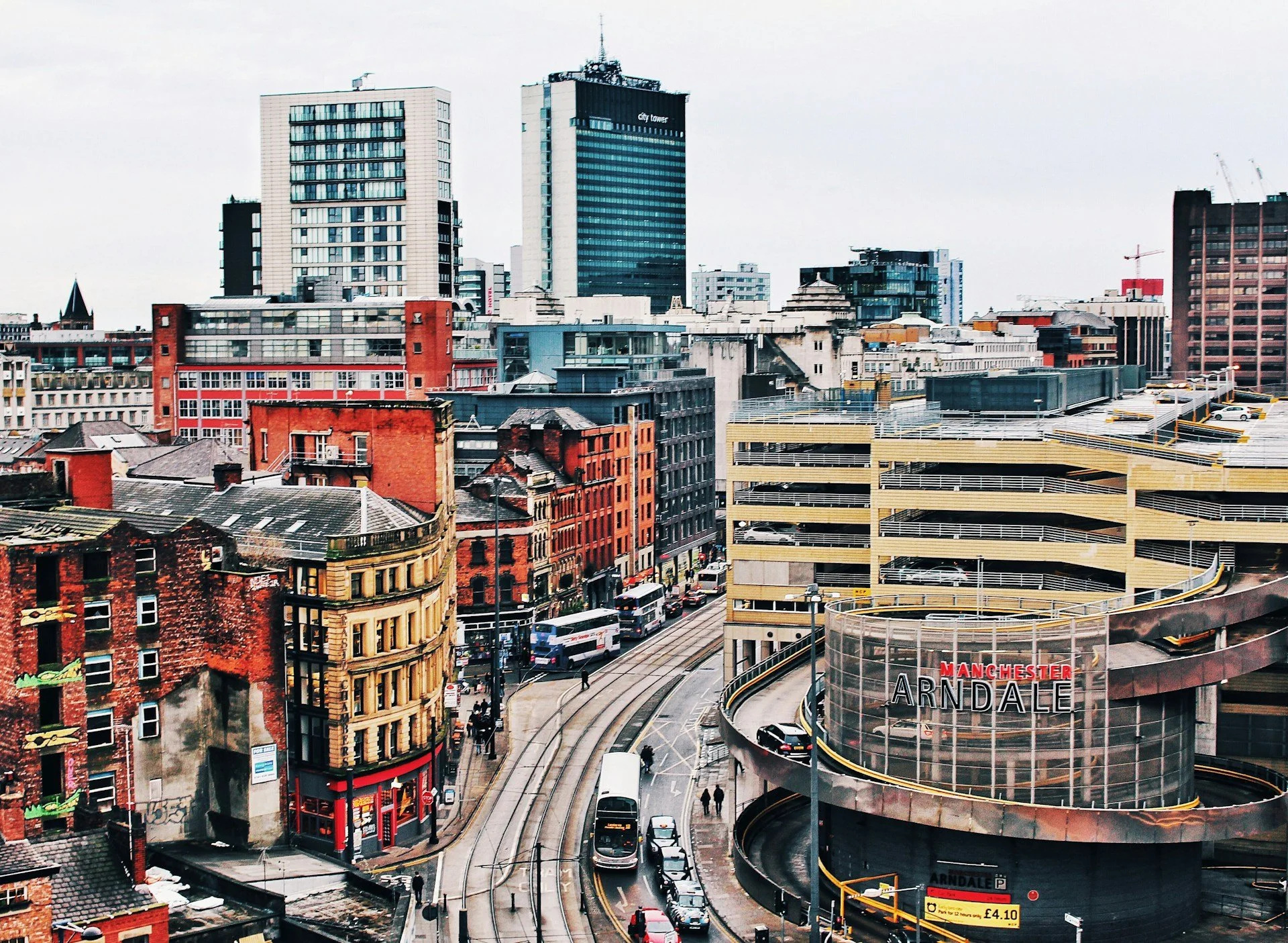
Photo by William McCue on Unsplash
By Tim Thorlby
5 min read
We hear a lot about Manchester. It is now regularly trailed as the city (after London, of course) for others to emulate. A roaring economic success! The media like to call Andy Burnham ‘the King of the North’. So, what’s all the fuss about? Is Manchester really a model for the future? Or is this just a rather good piece of myth-building?
In this blog I review the long-term evidence for how Manchester has changed over the last 20 years and try to work out what lessons we might learn from it.
Welcome to Manchester!
Manchester shot to global fame for the first time in the 19th Century. An unremarkable northern town became the epicentre of the worldwide industrial revolution. Manchester was a focus for the cotton processing industry - manufacturing textiles and exporting them around the world. It was the world’s first industrial city, dubbed ‘Cottonopolis’, growing rapidly and haphazardly from a small town to a city of over 600,000 people by the end of the 19th Century.
Great wealth was made by a few industrialists, although the conditions for most of the workers were shocking. Friedrich Engels described Manchester as ‘Hell upon Earth”. The city’s dependence upon cotton from north American plantations also made it a beneficiary of the transatlantic slave trade. This history is still being unearthed.
After its heyday in the early 20th Century, the city de-industrialised to a large extent after the Second World War, entering a period of decline, before finally beginning its long regeneration in the 1990s. The city has benefited from all sorts of investments since then, including a revamp of the city-centre, regeneration of Salford Quays (now home to the northern branch of the BBC), expansion of its universities and development of the Metrolink tram network.
The city also has a reputation for music and culture, with the 1990s bringing us the likes of the Stone Roses and the Happy Mondays on the ‘Madchester’ scene and the rise of those nice boys Liam and Noel, in Oasis. The city was actually famous for music well before then too, although 1970s punk bands like Ed Banger and the Nosebleeds are not so well known these days.
Greater Manchester is also home to one of the world’s oldest football clubs – Oldham Athletic, founded in 1895. Its greatest performance came in 1915 when it came second in Division One. There are other football clubs in the city too.
I could go on, but you get the idea. It’s a big, busy place. Greater Manchester is home to 2.8 million people, making it the second biggest city-region in England, after London.
It’s important to grasp that the City of Manchester and Greater Manchester are not the same place. ‘Greater Manchester’ is a city-region, comprising some ten local authorities – the City of Manchester itself, surrounded by Bolton, Bury, Oldham, Salford, Rochdale, Stockport, Tameside, Trafford and Wigan. This is also the area covered by the Mayor of Greater Manchester (currently Andy Burnham) and the Greater Manchester Combined Authority (GMCA) which the Mayor leads.
So, what’s the story (morning glory)?
So, let’s look at Manchester’s regeneration since the 1990s. What has been going on? This is a high-level view of a complicated picture.
Part 1: Build, Baby, Build
Firstly, the most striking feature of Manchester’s change over the last 25 years is simply the rate at which its population has grown, deliberately enabled by Manchester City Council and its very consistent focus on this over many years. The city wanted to grow, they put plans in place to grow and….it grew:
The City of Manchester has seen strong growth this century. Over the last 23 years, the city has grown by almost 40% overall, in one generation. That is a rate of 7,300 people every year (c1.5% pa). That is a lot. It is far above the UK rate of growth.
From 2001 to 2011, the population grew from a historically low 422,000 up to 503,000, a huge growth rate of 20% in one decade and the fastest growth outside of London during this period.
Then from 2011 to 2021, it grew by another 10% to 552,000 people.
Currently, the ONS estimates the population at 590,000 (2024), showing that the city is still growing robustly
Within Manchester, the city-centre district has been deliberately targeted by the council as a place for population growth. The core of the city centre is the former ‘Central’ ward, which is now two wards (Deansgate and Piccadilly). This area has seen the population more than treble from 11,689 in 2001 to 37,626 in 2021. This includes students, as well as residents. Residential development has been targeted at a much broader area than this though, covering much of the area around the city centre.
Greater Manchester as a whole has seen its population rise from 2.4m in 2001 to 2.8m in 2021, a rise of 15% in 20 years. This is just above England’s average growth rate over the same period and largely driven by the City of Manchester at its heart. Growth in the rest of the city-region has been much slower and more uneven than in the City.
Part 2: The economy is growing too
Over the last 20 years, Greater Manchester’s economy has grown in size faster than any other city in England, second only to London. Manchester has seen average annual growth of GVA (Gross Value Added) from 2002 – 2019 of 2% pa, compared to 2.6% pa in London. It has actually been speeding up a little in recent years too.
Greater Manchester now has an economy worth £93 billion (GVA, 2023), second only in size to London.
This is impressive. Although, given the rate of population growth, you would expect the economy to have grown. More people means a bigger economy. The housing boom has been matched in the centre of Manchester with an office boom too, to ensure that people have jobs to do. More people, more jobs.
Question…?
Growing a city is an impressive thing in itself, it’s a huge construction challenge. But the question is whether Manchester has done more than just grow. Is that the Manchester Thing – rapid population growth, enabled by lots of property construction? Or is there more to it? Has it also strengthened or developed its economy in any important way over this time too?
Is it a Champagne Supernova?
How can we best understand the nature of the economic change that’s been happening in Manchester? What exactly is going on? Should we hand out the champagne?
There are lots of questions we could ask here, but let’s ask four big ones to see if all of the excitement about Manchester’s economy is warranted, beyond its ability to grow in size:
Q1: A Regional Question - Is Greater Manchester closing the gap with London?
In short, no. Although, nowhere in the UK has been closing the gap with London in recent decades, so Manchester is in good company. Greater Manchester has continued to fall behind London and the South-East and the North-South divide has continued to grow all the time that Manchester has been growing. London still has all the Magic Economic Sauce and they have not been sharing it (largely thanks to HM Treasury and its London bias, but that’s another blog).
Q2: A Productivity Question – Is Greater Manchester increasing its productivity faster than everywhere else?
Greater Manchester’s economic productivity (GVA per hour) is well below Greater London (35% lower) and also below the UK average and has been for a long time. Encouragingly, since the financial crash, Greater Manchester’s growth in productivity has exceeded that of any other city-region, including London. From 2008 – 2023, it averaged 1.2% pa, compared to the UK’s 0.5% pa over the same period[1]. However, the rate at which Manchester is ‘catching up’ is modest; the Resolution Foundation noted that it would take 90 years for Manchester to just close the productivity gap to 20%.
So, Manchester’s productivity is indeed growing faster than most other places, but only by a modest amount.
The employment rate here is below the national average too, a reflection of the economic inactivity rate (those who don’t work or are not looking for work), so there is a wider issue here of getting people into work in the first place too.
Q3: A Skills Question – Have the people of Greater Manchester been skilling up with qualifications faster than everyone else?
A key measure today is how many people in a city are qualified to degree level or above. In 2021, the last Census showed that Greater Manchester has 31.9% of its people with a Level 4 qualification or higher. This is 2% points below the UK average[2].
Compared with 2001, twenty years ago, Greater Manchester has a lot more graduates now (as all our cities do, because we have a lot more graduates overall) but it has only closed the gap with the national average by 1% point. At the present rate of change therefore, it will take Manchester another 40 years to reach the UK national average skills level. So, it has certainly made progress, but only by a small step.
Q4: A Wealth Question – Are the people of Greater Manchester growing wealthier faster than everyone else?
For those in work in Greater Manchester, weekly pay for the ‘median worker’ (the one in the middle of the income ladder) remains well below the UK average. In 2021, the typical Manchester worker took home £567 per week, compared to £611 per week for the typical UK worker (Greater London is far ahead in the distance on this one).
Has the gap been closing? Not really. From 2014 to 2021, the previous 7 years, the gap between Manchester and the UK has actually widened slightly[3].
Looking at a slightly broader measure of household (Gross Disposable Household Income), we can see that households in Greater Manchester certainly have greater income in 2023 than in 2000, but during this time have continued to fall further behind households in the UK as a whole. In 2000, household income was 89% of the national average. By 2023, it was 84%, no doubt driven by the growth of wealth in Greater London in particular.
Poverty in Manchester also remains extensive. Some one in four neighbourhoods in the city-region remain in the bottom 10% in England[4] (i.e. 23% of LSOAs, 2025 IoD). This has not changed since the last review in 2019. Manchester City itself has actually deteriorated in its position in the last 6 years and is now the fourth most deprived local authority area in England.
Is Manchester winning on wealth? I’m not sure it is.
A summary
Greater Manchester has achieved extraordinary growth over the last 25 years – housing, people, jobs – and built a renewed sense of confidence in the city, perhaps even a swagger. Many people clearly love living in the city too. I am not here to do it down.
But apart from some modest skills and productivity improvements, Greater Manchester’s long-term trajectory is still not closing the gap with the UK average on many indicators and is not even close to closing the gap with Greater London.
The successes of its city-centre economy are also not being well distributed across the city-region as a whole, where wide disparities remain between the ten local authorities.
Don’t Look Back in Anger (learn the lessons)
Greater Manchester, then, is an example of how to deliver robust physical growth – property-led regeneration. The city planners are the heroes here, partnering with developers and investors and others, to help Manchester overtake Birmingham as England’s second city.
It has also demonstrated that it is more than capable of taking on extra responsibilities through the devolution of power and funding from Westminster. The Chancellor’s recent announcement about fiscal devolution to such city regions is very welcome and is based upon her confidence that places like Manchester will know how to use the extra funds and flexibility well.
But has Manchester pioneered a different approach to building economies or investing in education or distributing wealth? It’s not clear that it has. Yet.
The lesson here is that growth alone does not solve all of our problems – the idea that if we expand then wealth and opportunity will somehow ‘trickle down’ is a myth. All of these other challenges require intentional strategies and just as much energy and focus as the push for growth.
Some might say….
Some commentators have also raised some important questions about the nature of the physical regeneration in Manchester. A recent study (Goulding et al, 2025)[5] has analysed how the private investment required to fund much of the construction was partly secured by requiring very low affordable housing contributions from housing developers. The study also highlighted how much of the new rental housing is owned by national and global investors, and so as rents have risen, significant flows of capital have exited Manchester. Their argument is that the city may have grown but even the residents in new jobs in new houses may actually not be much better off overall if their higher salaries are taken away by higher rents.
Their question is whether it’s possible to regenerate our cities by using more locally rooted investments and with more affordable housing as part of the mix. It’s a good question. There is more thinking to be done on what a sustainable model of English Urban Renewal looks like.
So, if you are the leader of an ambitious City Council, Manchester will show you how to accelerate physical growth, but you will need to reflect hard upon what other lessons you may want to take away from this.
You will also need to devise your own ideas on how to raise productivity, invest in greater skills and drive social mobility across your city.
There remains an urgent need for more thinking on all of these issues in our cities. If there is more devolution of powers and funding to local government in England, hopefully there will be greater innovation in the future.
Our cities also need to be backed by a national commitment to regional development from Government. We still lack any serious strategy for closing the North-South divide. It requires a plan and investment. It is probably the most consequential thing a Westminster government could do to accelerate the UK’s sluggish economic growth.
It still feels to me that we are a long way from that - perhaps still half the world away.
This blog was written by Tim Thorlby. It may contain Oasis lyrics, sorry I couldn’t help it. Please sign up if you’d like to know about future blogs, usually published once a month. (It’s free)
Notes
[1] See data from the Productivity Institute | Access: https://lab.productivity.ac.uk/insights/2025-edition-of-the-mca-productivity-scorecards-dashboards/
[2] See GMCA Census Briefing | Access: https://www.greatermanchester-ca.gov.uk/media/7876/230414-qualifications-accessible.pdf
[3] Data from the Greater Manchester Independent Prosperity Review Evidence Update on the Labour Market, 2022 | Access: https://www.greatermanchester-ca.gov.uk/media/6717/gmipr-evidence-update-the-labour-market.pdf
[4] That is, 23% of the LSOAs in Greater Manchester are in the bottom 10% LSOAs in England, from the 2025 English Indices of Deprivation | Access: https://www.greatermanchester-ca.gov.uk/media/zxoglkwz/research_gmca_imd_v2.pdf
[5] Goulding, R (2025) Centripetal Cities: A critique of supply-side urban development, University of Sheffield | Access: https://sheffield.ac.uk/crafic/news/new-report-critiques-supply-side-urban-developmen